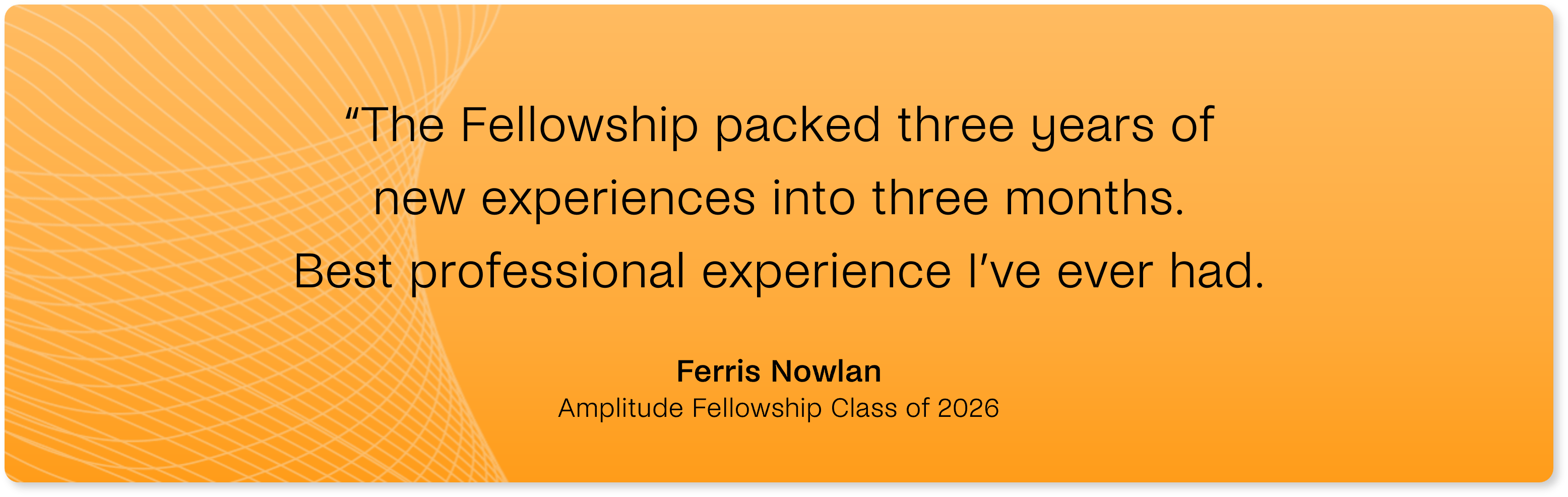
"The Fellowship packed three years of new experiences into three months. Best professional experience I’ve ever had." That's how Ferris Nowlan (Molecular Genetics PhD, University of Toronto) described her summer as an Amplitude Fellow. It’s a striking statement. And that’s the whole point of the Amplitude Fellowship, a paid, in-person and full-time summer program run by Amplitude Ventures, Canada's leading biotech and healthcare venture fund, and Pre-Amp, its venture creation studio.
Every year, between 6 and 10 of the top life sciences PhD candidates, postdocs, and MDs from across the country gather in Montréal and spend their summer exploring whitespace ideas to create tomorrow’s biotech companies supported by the Amplitude team.
From day one, Fellows set aside their own research. They're sorted into small groups, assigned a scientific field they've never worked in, and given a month to answer several hard questions: What's the big idea? How far can we push it? And what could it become?
That approach runs against how most Fellows have been trained in the lab. Whether they come from a PhD, a postdoc, or medical training, they have spent years going deep on narrow questions. The Fellowship asks them to do the opposite: go wide, move fast, and form a view before they feel ready.
For this year's class, that was the part they valued most. In fact, Fellows described work that challenged them and reignited a curiosity they hadn't felt in a while. This is the first of three posts giving you a view into what it's like to be an Amplitude Fellow. If you're curious about the Fellowship or the nontraditional career paths that science can take you down, keep reading.
How the Amplitude Fellowship works
Fellows spend the summer working side by side with the Pre-Amp and Amplitude teams in downtown Montréal. The Class of 2026 came from five top Canadian universities: McMaster University, Queen's University, the University of British Columbia, the University of Calgary, and the University of Toronto. Their backgrounds range from neuroscience and chemistry to biomedical engineering.
The summer runs in three one-month cycles or explorations. The first is a landscaping exploration, where Fellows map an unfamiliar scientific field end to end and apply the rigour of their training to territory they've never studied. The second exploration often involves putting Fellows to work directly on projects for Amplitude portfolio companies. The third is a blue-sky exploration in another new field, where Fellows draw on everything the first two cycles taught them to push an idea as far as it will go. Their efforts ultimately culminate in a presentation at the venture creation symposium, where the Fellows showcase their best work to more than 100 founders, operators, and investors. The strongest ideas can become the foundation for new companies that Pre-Amp refines, builds, and launches from scratch. In fact, more than one Amplitude portfolio company started out as a Fellowship exploration.
Learning a new field, fast
There's no home turf in the Amplitude Fellowship, and that's by design. The program is built to sharpen Fellows' instincts as researchers and entrepreneurs. This summer, for example, Fellows took on neurology, non-T-cell engagers, women's health, and glycobiology, all areas that were new to this year's class. A newcomer sees a field without the assumptions specialists carry. The catch, as Elizabeth Culp (early career scientist, Biochemistry PhD, McMaster University) pointed out, is that an idea that feels original often turns out to be well-established research. Learning to spot that pitfall quickly is part of the training.
Fellows also learn to go broad before they go deep. Before chasing any single question, they map the whole field.
"Getting oriented in a new field means you first learn the major findings and then go looking for the specific answers you need," says Ferris. "It’s a really different way of engaging with science. You’re constantly connecting ideas, identifying knowledge gaps, and figuring out which questions are worth pursuing."
Working at this pace takes discipline. Fellows learn to focus on core concepts, prioritize the questions that drive a decision, and avoid the rabbit holes. They also draw on skills from their academic training, such as knowing the fastest way to get up to speed on a complex field.
The Amplitude Fellowship is also very much a team sport. Each member of a group brings a different scientific background and expertise, so what one person doesn't know, another often does. Working together, a group can learn a new field much faster than any one Fellow could alone.
Ready for whatever science comes next
Fellows walk away with a skill few academic programs teach: the ability to step into an unfamiliar field, get up to speed fast, and find an idea worth chasing. Many also realize they don't need to know everything about a field to make a real contribution.
"I was often the least experienced person in the room on the topic," says Maria Teodora Secara (Medical Science PhD, University of Toronto). "It showed me I don't need deep expertise to learn a field, think critically about it, and contribute to a team."
That confidence sets up the next challenge. Once Fellows can learn a field fast, they face a tougher test: Could one of their ideas actually become a company?
This is a three-part series, stay tuned for part two coming soon.
Think you're up for it?
Applications for the 2027 Amplitude Fellowship are open now. The deadline is January 17, 2027.
Click here to sign up for information sessions in person and online.