Science is full of interesting ideas. Very few of them can become companies. The difference often comes down to one question: What can this science do that nothing else can?
That question came up again and again for this year's Amplitude Fellows. For Arjun Raha (Biomedical Engineering PhD, McMaster University), it came to a head late in the summer. His team spent hours debating glycobiology, the science of the sugar chains attached to proteins and cells. The science was interesting, but the team kept coming back to a harder question: Could it actually support a company?
A scientist in a lab asks whether something is true and interesting. A company builder asks whether an idea is different enough, and valuable enough, to build a business around. Learning to ask that second question is at the heart of the Amplitude Fellowship.
The Amplitude Fellowship is a paid summer program where 6 to 10 PhD candidates, postdocs, and MDs work with Amplitude Ventures and its venture creation studio, Pre-Amp, to explore ideas for new biotech companies. Part 1 in this series covered how the program works and how Fellows learn new fields fast. This post looks at what they do with that knowledge.
Shaping the hypothesis
Each exploration the Fellows undertake aims to produce a venture hypothesis. This is a clear, testable statement about a company that could exist. The Pre-Amp team judges each one on three criteria: Does it create real value for patients? Is the science feasible to prove out? And can the team tell a story?
Getting there starts with finding whitespace, meaning a gap where no one else is working and a new approach could make a big difference. Maria Teodora Secara (Medical Science PhD, University of Toronto) described it as finding a sweet spot: an idea new enough to stand apart, but testable enough that its core assumptions can quickly be proven or disproven. Her team started with a broad scientific opportunity and narrowed it down to a specific unmet need, a technical advantage, and a set of experiments that could quickly show whether the idea was worth pursuing.
That process changes the question a scientist asks. "Is this interesting?" becomes "What would have to be true for this to become a company, and how fast can we test it?"
Knowing the competition
Before an idea goes anywhere, Fellows map the field around it. They look at which companies and research groups are working on the same problem, what's in development, and where the gaps are.
For several Fellows, this was eye-opening. Whatever area they studied, they found a crowded field of biotechs and pharma companies already at work. One Fellow said the exercise made him much quicker at telling a truly differentiated idea apart from good science aimed at the wrong problem.
The Fellows also learned to define what success would look like. Logan Germain (Biomedical and Molecular Sciences PhD, Queen's University) used a target product profile, or TPP, during her final exploration. A TPP spells out what a future drug would need to achieve to win, from how it's delivered to how it compares with existing treatments.
"This framework was especially useful for understanding the parameters of reality for drug delivery while simultaneously considering what would make a drug competitive within a given indication based on the current and projected competitive landscape," says Logan.
Telling the story
A strong idea still has to convince people. For Arjun's team, that meant studying the history of therapies in their area: what had been tried, why some programs failed, and what problems remained unsolved. That history revealed unmet needs that weren't obvious at first.
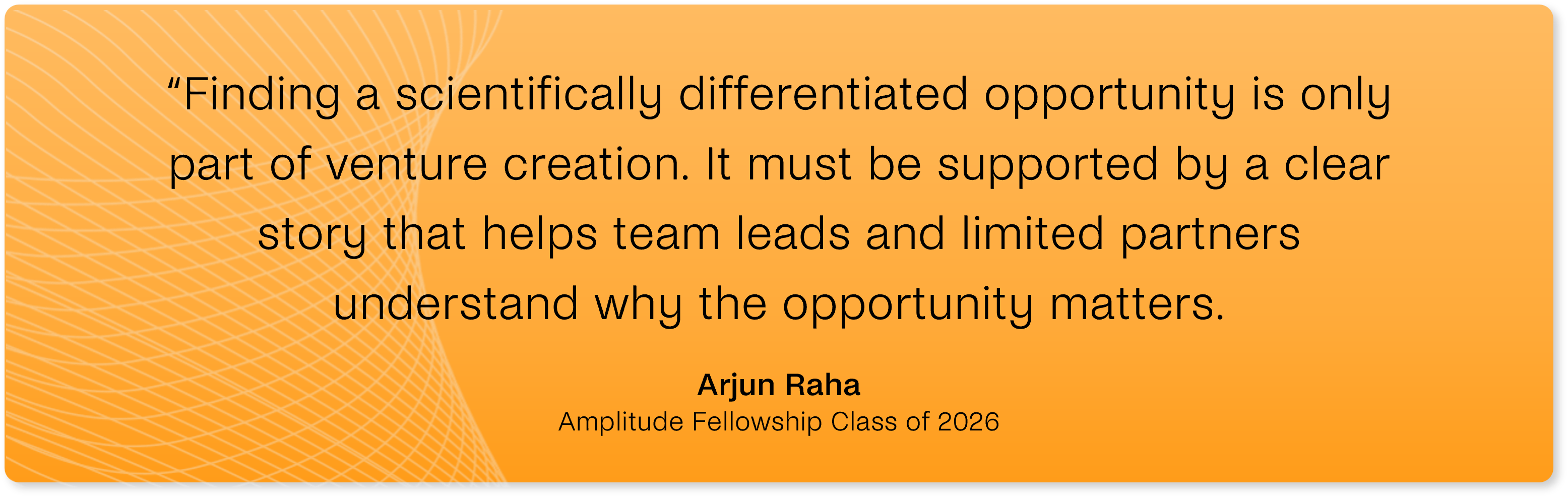
"Finding a scientifically differentiated opportunity is only part of venture creation," notes Arjun. "It must be supported by a clear story that helps team leads and limited partners understand why the opportunity matters."
Ultimately, those stories are showcased at the venture creation symposium that wraps up the Fellowship, where Fellows pitch their best ideas to more than 100 founders, operators, and investors. From there, the best hypotheses can move into Pre-Amp's refinement and de-risking stage and, eventually, may even launch as new companies. That's the very path that Amplitude portfolio companies Stereo Biotherapeutics and RIME Therapeutics, among others, followed.
Learning from the wider network
The explorations are only part of the summer. Alongside them, Fellows take part in webinars and training on topics such as platform intellectual property strategy and industry resources, hear company creation stories from founding CEOs in Amplitude's network, and sit down with leading biotech executives. Arjun singled out the seminars on IP strategy, market landscaping, and venture capital structure as some of the most valuable parts of the program.
Throughout the summer, Fellows also have mentors close at hand. They partner with Pre-Amp's Venture Associates Eric Desjardins, Laura DiGiovanni, and Madison Bolger-Munro, along with Venture Manager Virginie Petel Légaré, all of whom are Fellowship alumni.
There's time to connect outside the work, too. The venture creation symposium doubles as a chance to meet the wider Amplitude community, and social events bring Fellows and alumni together over a beloved Montréal after-work tradition: the Cinq-à-Sept.
Bringing the question home
For Arjun, the glycobiology debate didn't really end when the summer did. He co-founded a startup through his PhD research, and he now plans to put it through the same test his team used during the Fellowship, checking whether the science holds up, whether it offers real clinical value, and whether there's a viable business behind it. What he finds will help him decide whether to push forward or redirect his energy toward a stronger opportunity.
Fellows leave with a way of judging science that they can apply to any idea, including their own. Where they take it from there looks different for everyone.
So where do they go next? Find out in Part 3 of Inside the Amplitude Fellowship. Read the first part of series here.
Ready to think beyond the lab? Applications for the 2027 Amplitude Fellowship are open now. The deadline is January 17, 2027. Click here to sign up for information sessions in person and online.